
Finding the Story in the Music
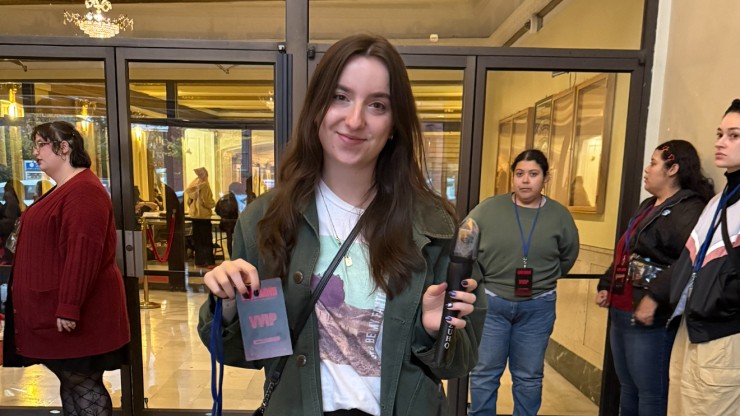
Gabrielle Bonin ‘26 didn’t arrive at Dean with a perfectly mapped-out plan. What she had instead was something more instinctive: a lifelong connection to music and a curiosity about how live experiences come to life behind the scenes. Concerts, for her, were never just events, but moments that stayed with people, something she wanted to be part of creating.
That instinct led her to Dean’s Arts & Entertainment program, but it was what happened next that began to shape her path in ways she hadn’t anticipated.
In one of her first classes, Gabrielle mentioned her interest in the industry. It was a passing comment, but her professor, Dr. Petrarca, took notice. He had already seen her ability as a writer and the clarity with which she spoke about music. At a larger institution, those observations might have remained just that. Here, they became a starting point.
After class, he offered to introduce her to his son, Valentino Petrarca, the Chief Editor of The Aquarian, a longstanding music publication.
Gabrielle followed up, expecting a brief conversation to learn more about the field. Instead, she was invited to attend a show and try writing a review. Her first assignment was a concert by SF9, a band she had followed for years, which made the opportunity feel both exciting and a little daunting.
“I was definitely over the moon,” she says.
At the same time, she wasn’t entirely sure what to expect of herself. She had little professional experience and questioned whether she was ready, but chose to move forward anyway. She wrote the review, submitted it, and soon after saw it published.
The experience shifted something. What had once felt like an interest began to take on more shape, a direction she could begin to see for herself. She had found a way to translate her perspective as a fan into something professional, something that could reach an audience beyond the venue.
A second assignment followed, covering a Steve Aoki show. This time, she also stepped into concert photography, expanding her skills as she went. Each experience built on the last, and while the initial uncertainty never fully disappeared, it became easier to move through with each new opportunity.
“I questioned if I was good enough,” she says. “But I wasn’t going to let that stop me.”
That willingness to try, and to keep going, has been reinforced by her experience at Dean. In smaller classes, conversations with faculty tend to extend beyond coursework, creating space to talk more openly about interests, goals, and possibilities. Gabrielle found that those conversations often led somewhere more concrete.
“At Dean, I’ve been able to make real connections with my professors,” she says. “When you go beyond just coursework and share your goals, they want to help.”
In Professor Rowell’s courses, she developed a stronger sense of how to communicate and advocate for herself in professional settings. In other classes, she found that sharing her interests could open doors, especially when faculty had the time and perspective to make meaningful connections.
For Dr. Petrarca, this kind of moment is a familiar pattern. After teaching at institutions with lecture halls of 100 students, he sees the difference every day. Smaller classes make it possible to understand who students are, what they care about, and where they have potential to grow.
With Gabrielle, that meant recognizing the intersection of skill and passion early on, then helping her act on it.
“If we can connect what a student is good at with what they love,” he says, “we can start to explore where that might take them.”
Now, Gabrielle is continuing to build on that experience, developing both her writing and photography while exploring a future in music management. She hopes to eventually interview artists directly, bringing their stories to life in the same way she once experienced them as a fan.
Looking back, the turning point wasn’t a formal milestone, but a conversation that led somewhere. At Dean, those moments tend to carry further than expected.